River Witham Sword
10th-century Type S sword · Historical reconstruction · Queen’s Prize, 2025
About this piece
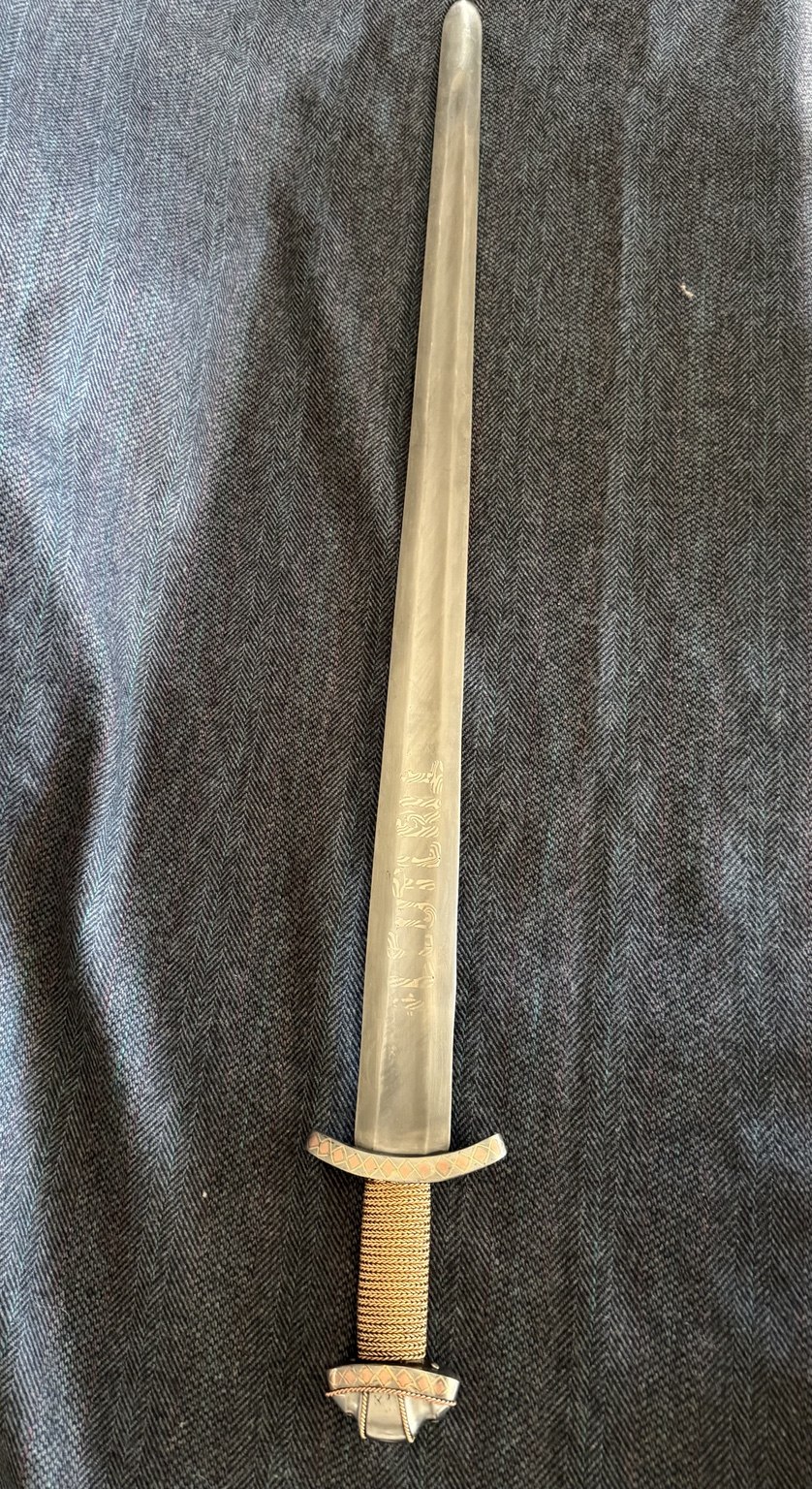
This sword was made for Queen’s Prize in 2025 as a study of a tenth-century weapon recovered from the River Witham near Lincoln, England. The original, held by the British Museum (1848,1021.1), combines an inscribed blade, a down-curved guard, and a distinctive trilobate pommel. Recreating those features brought together several techniques I wanted to understand better: forge-welded blade inscriptions, wrought-iron hilt construction, and decorative non-ferrous inlay.
This is a reconstruction informed by a specific surviving artifact, not a claim of exact replication. Where I chose different materials or methods, those differences are documented below.
The historical sword
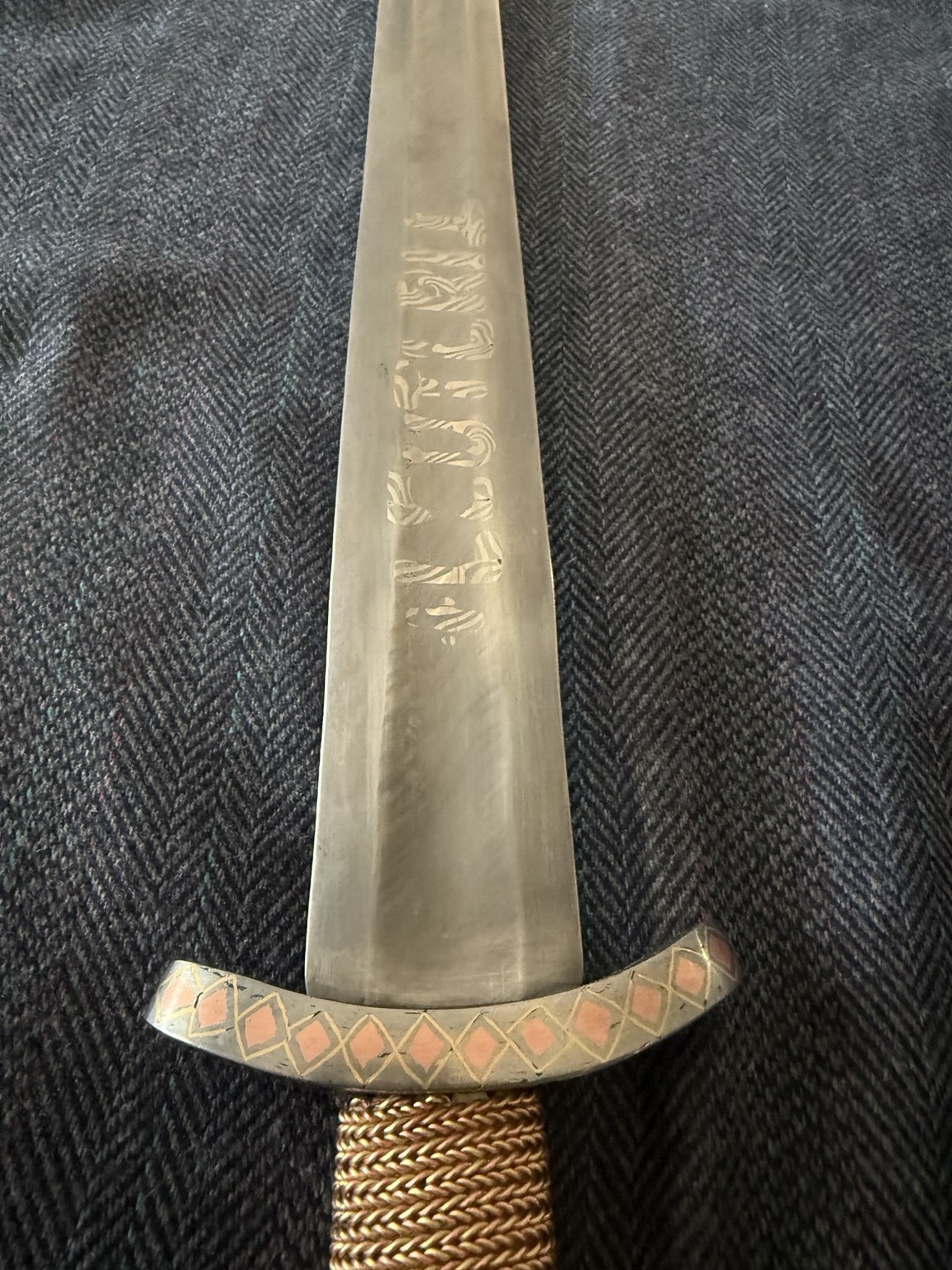
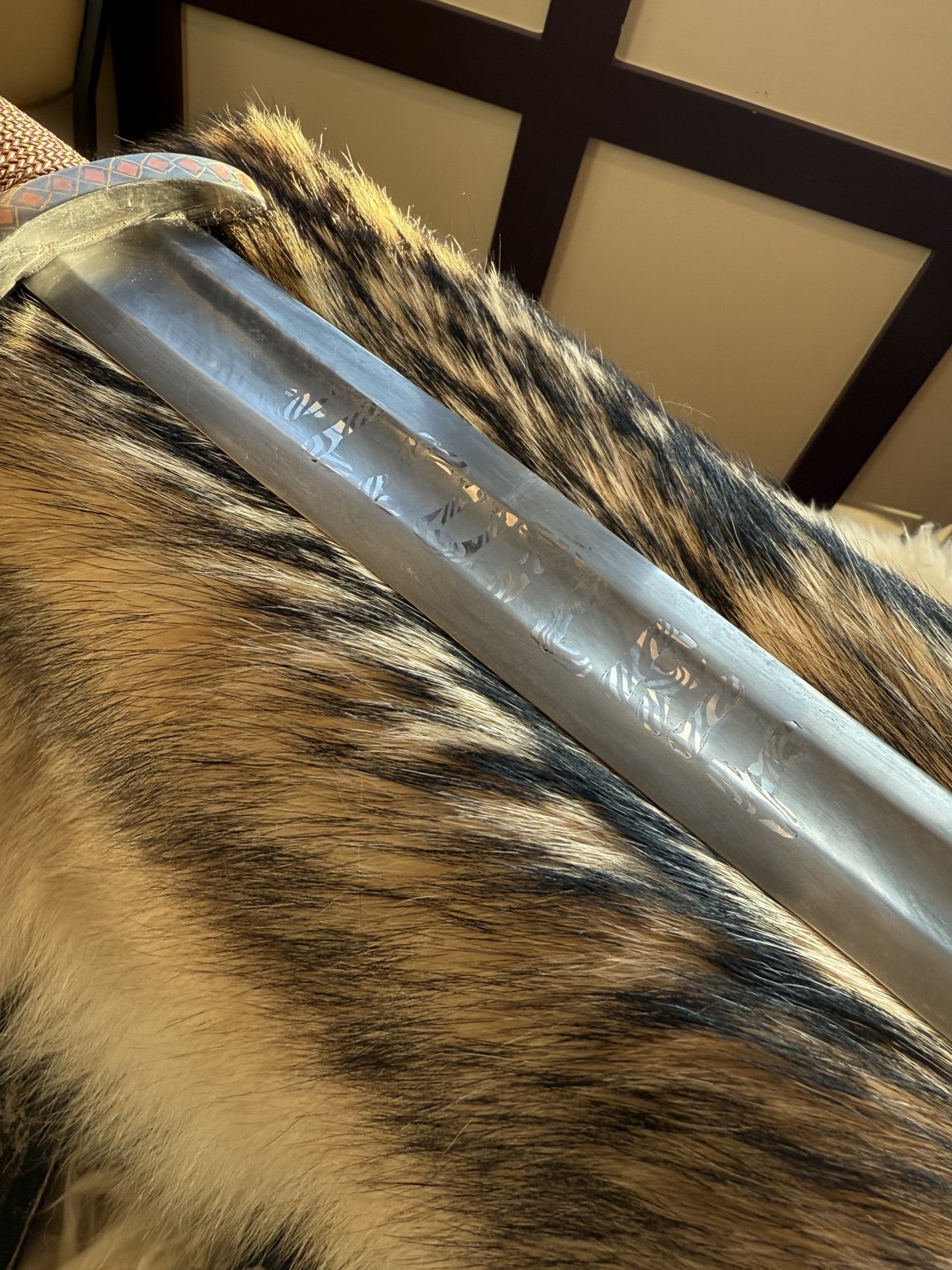
The River Witham sword is identified as a Type S sword from the tenth century, associated with the late Anglo-Saxon and Ottonian world. The blade has a fuller on each face. One side bears the inscription +LEUTLRIT (with the final T inverted); the other has an S-shaped scroll motif. The meaning of the inscription remains uncertain.
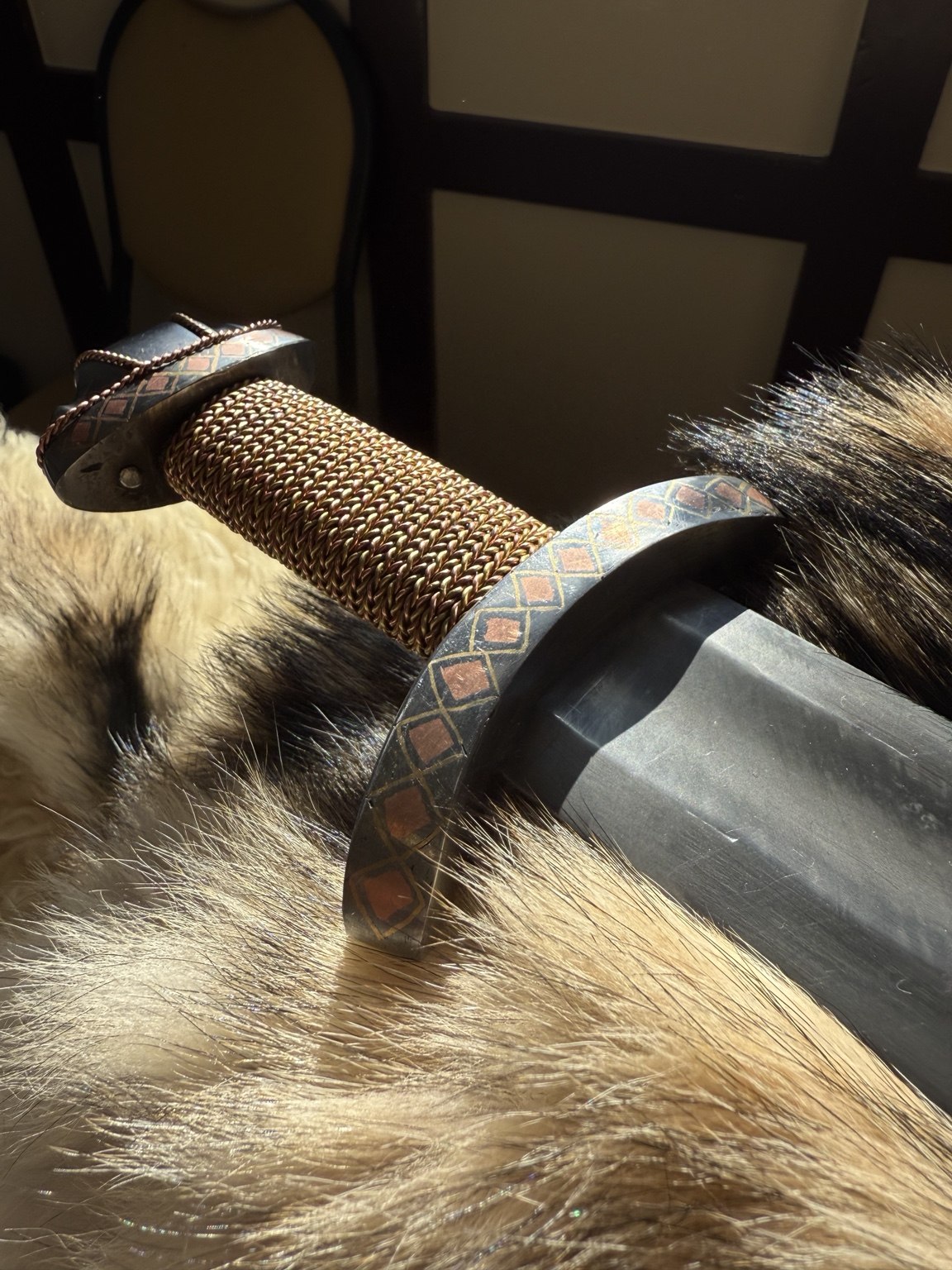
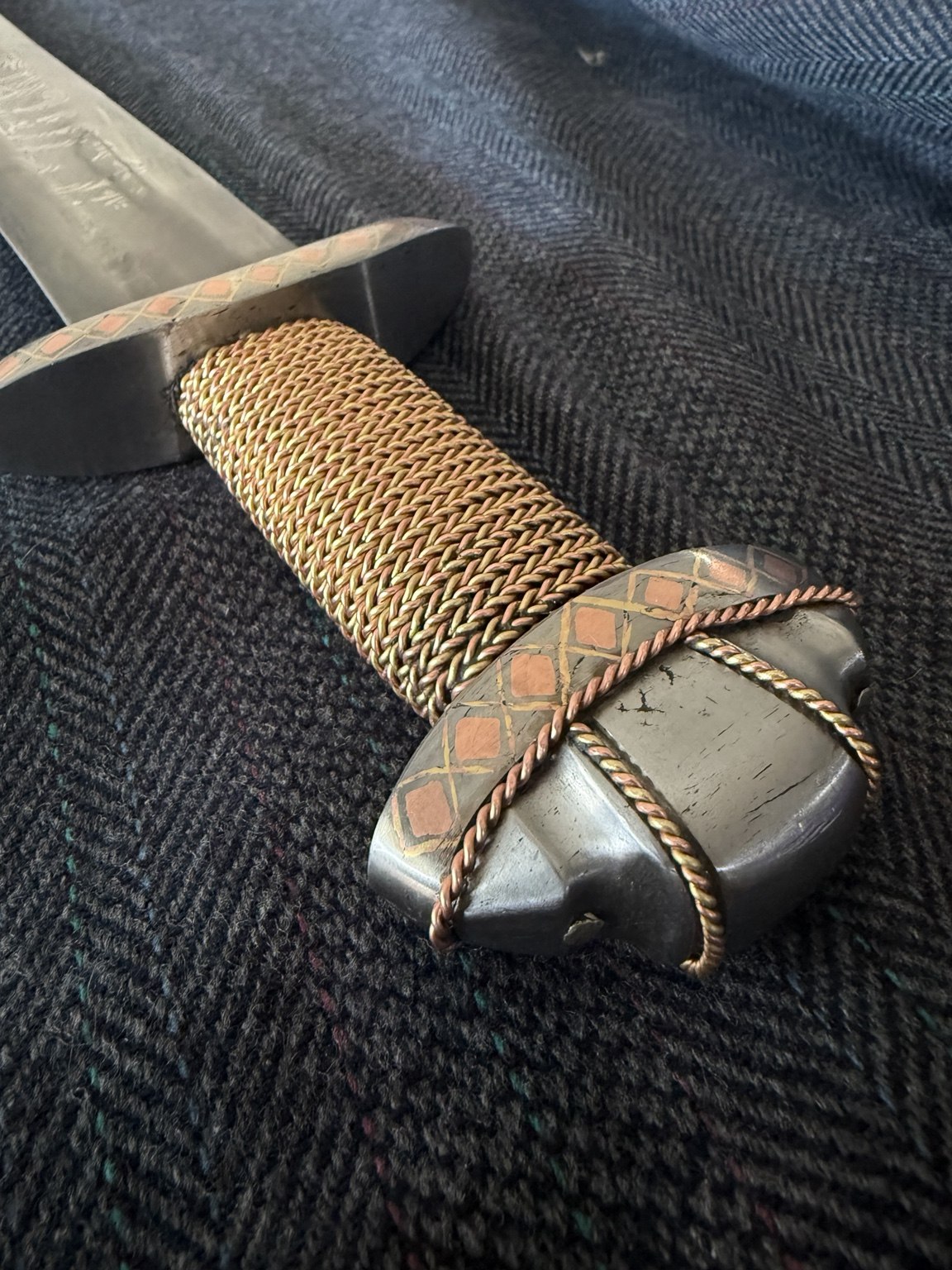
Its down-curved lower guard and trilobate pommel carry geometric lozenge decoration. The British Museum also records twisted-wire ornament and a pommel attached to the upper guard by two rivets, a detail I did not reproduce in my own assembly.
Materials and construction
I forged the blade from 1075 steel. For the lettering and scrollwork, I made seven-layer billets of alternating 1075 and 15N20, twisted them, and forged the material into shapes that could be welded into engraved grooves in the blade. The nickel-bearing 15N20 produces contrast after etching. The original sword's ferrous inlay is described in my research as wrought iron; my twisted modern-steel inlay is therefore an intentional interpretation rather than an exact material match.
The guard and trilobate pommel were forged from wrought iron. I engraved the lozenge decoration, prepared the grooves with cross-hatching and undercuts, and set copper and brass wire into the fittings by peening and burnishing. The grip has an oak core wrapped with twisted copper and brass wire. I assembled the hilt with a peened tang; the museum description records a different riveted method for fastening the original pommel.
Measurements
These are the measurements recorded in my A&S documentation. They help show where my finished sword differs from the museum original.
| Measurement | Original | My sword |
|---|---|---|
| Overall length | 915 mm | 925 mm |
| Maximum blade thickness | 7.5 mm | 6.0 mm |
| Blade width at base | 60 mm | 49.5 mm |
| Lower guard width | 118 mm | 110 mm |
| Weight | 1,214 g | 1,112 g |
A failed first attempt
My first attempt at this sword failed. I ground the fullers into the blade before trying to forge-weld the letters into place. That left too little material beneath the grooves. At welding heat, the thin section burned through and the blade was ruined.
For the next attempt, I changed the order of operations. I welded the inlays while the blade still had sufficient thickness, then ground the fullers afterward. That adjustment produced a more stable blade and better welds. It was a practical lesson in how the sequence of work can matter just as much as the individual techniques.
Heat treatment and finishing
My documented heat-treatment schedule used three normalizing cycles at 1500°F, 1400°F, and 1300°F, each held for eight minutes. I then austenitized at 1550°F for eight minutes, quenched in oil, and tempered at 450°F for two hours. I checked the blade's straightness and used a file test as a practical indication of hardening. Final polishing and etching brought out the contrast in the inlays.
What I would change
One of the most useful parts of the project came after the sword was finished. Roland Warzecha offered feedback on the grip: it should be slimmer, slightly waisted, and less full in the center. My first wire wrap and the method I used to anchor it added more thickness than I intended. I agree with that criticism, and I would approach the wrap differently on another sword.
I would also refine the blade's width and thickness, the guard proportions, the final polish, and protection of the inlays during heat treatment. Those are not reasons to hide this piece. They are part of what the project taught me.
Queen’s Prize
The finished sword was presented at Queen’s Prize, an Artemisia arts and sciences event, in 2025. Displaying the sword alongside the historical reference and its documentation was an opportunity to share not just the finished object, but the research, experiments, mistakes, and decisions behind it.
References
Atilivs Ironworks. (2025). River Witham sword: A&S documentation [Unpublished project documentation].
British Museum. (n.d.). Sword (museum number 1848,1021.1). https://www.britishmuseum.org/collection/object/H_1848-1021-1
Martens, I., & Astrup, E. E. (2021). Viking Age swords from Telemark, Norway: An integrated technical and archaeological investigation. Museum of Cultural History, University of Oslo.
Moilanen, M. (2015). Marks of fire, value and faith: Swords with ferrous inlays in Finland during the Late Iron Age (Archaeologia Medii Aevi Finlandiae, 21).
Petersen, J. (1919). De norske vikingesverd: En typologisk-kronologisk studie over vikingetidens våben. Jacob Dybwad.
Pleiner, R. (1992). Stähle, Steine und Schlangen: Studien zur europäischen Waffentechnik und Symbolik. Franz Steiner Verlag.
Williams, A. (2009). A metallurgical study of some Viking swords. Gladius, 29, 121–184.
The British Museum citation links only to its public collection record. Private working files and research copies are not linked or distributed.